
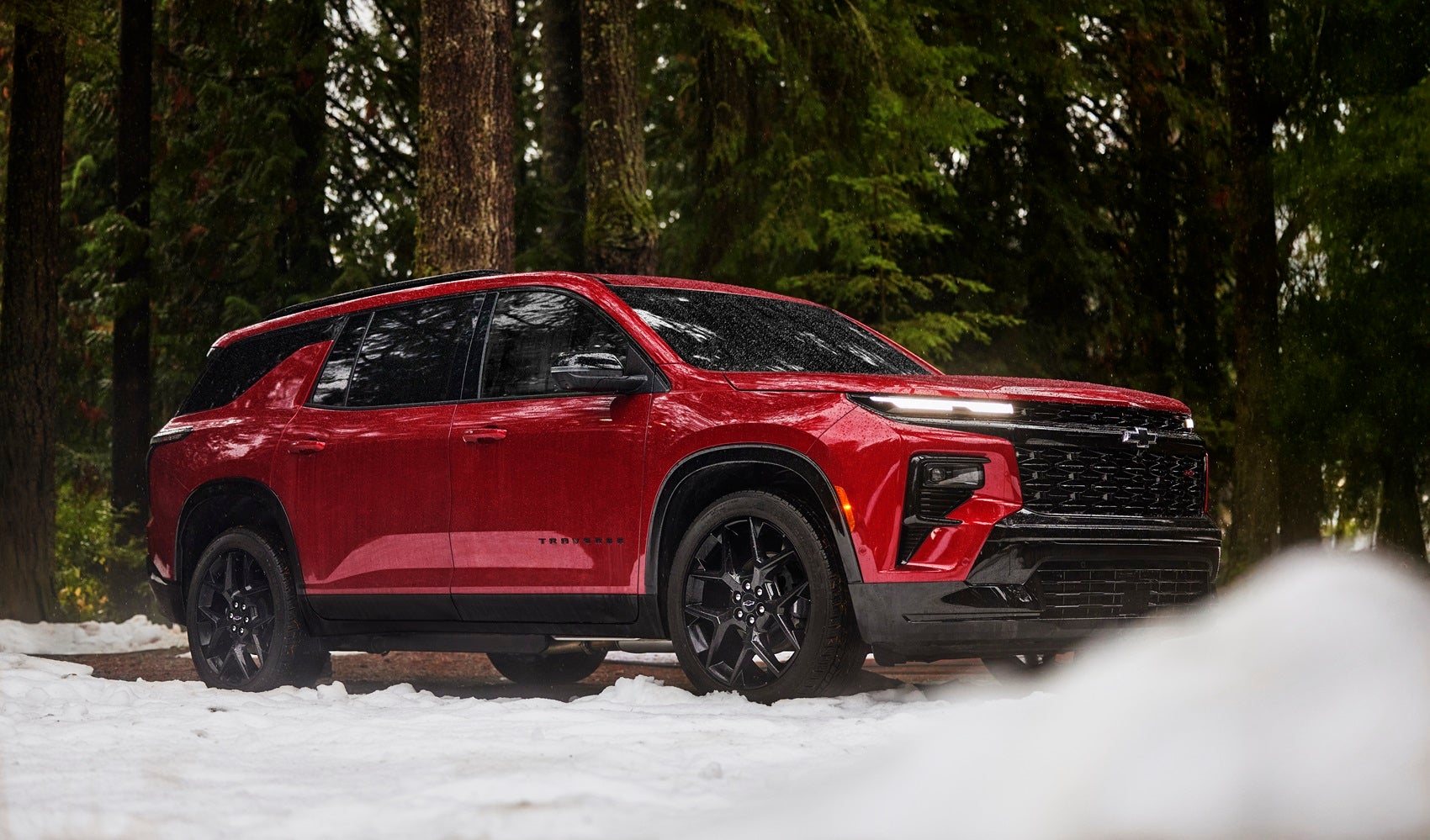
Chevy Traverse vs Ford Explorer
If you want a vehicle that’s tough enough for a weekend excursion but stylish enough for a night on the town, you have some great options in the Traverse and Explorer.
Andy Mohr Automotive wrote this Chevy Traverse vs. Ford Explorer vehicle comparison to help Indianapolis, Plainfield, and Bloomington, Indiana, drivers get a better idea of which one is the right fit for their lifestyle.
Key Takeaways
- The Ford Explorer has two engine options, and a higher horsepower and torque than the Chevy Traverse
- The Chevy Traverse can hold more passengers and has more maximum cargo space than the Ford Explorer
- Both the Chevy Traverse and Ford Explorer has abundant and impressive safety features
Chevy Traverse vs Explorer: Engine Efficiency
Both the Traverse and Explorer include available technology that preserves energy by turning off the engine when the vehicle comes to a complete stop.
The Chevy Traverse makes its Stop-Start Engine Control System a standard feature in all trims, as does the Ford Explorer with its EcoBoost® engines: the 2.3L EcoBoost® I-4 Engine and 3.0L EcoBoost® V6 Engine.
The Traverse generates a maximum horsepower of 328 and 326 lb-ft of torque with its 2.5L turbo engine with 8-speed transmission. The Explorer, on the other hand, generates a maximum horsepower of 400 and 415 lb-ft of torque with its available 3.0L EcoBoost® V6 engine.
Cargo Area in the Chevy Traverse vs Ford Explorer
Wondering when the Traverse pulls ahead? The Chevy Traverse has room for up to eight passengers, while the Ford Explorer has available room for up to seven passengers. In addition, the Traverse offers a maximum of 98 cubic feet of cargo space, compared to the Explorer’s 85 cubic feet.
Both SUVs provide ample and versatile cargo space, but each SUV has its unique methods when it comes to accessing that space.
The Traverse features smart-slide second-row seats that easily slide forward and fold upright. This is a quick way to create extra cargo room without folding down or removing seats.
The Explorer approaches the cargo area with available third-row PowerFold® seats. This folds the third row flat at the touch of a button for increased cargo space without any increased effort. Its E-Z Entry second row helps passengers get in and out of the Explorer more easily.
Both SUVs also feature an available hands-free automatic liftgate that makes them easy to load with full hands.
Traverse and Explorer Safety
The Chevy Traverse and Ford Explorer both have driver-assistive and safety features to keep you safe and make you feel confident while you’re on the road. Some standard features the SUVs have in common are:
- Forward Collision Alert with Automatic Emergency Braking
- Lane-Keeping System
- Rear Vision Camera
The Rear Vision Camera helps you see the world directly behind your SUV. You can use it to navigate obstacles, keep an eye out for pedestrians, and even nail those parallel parking spaces.
The Lane-Keeping System gets its best use on the highway. It monitors your position within the lane and warns you if you begin to drift out of it accidentally. The Explorer’s version even suggests a break if it happens a few times.
To help prevent accidents, both SUVs have Forward Collision Alert with Automatic Emergency Braking Systems. This feature keeps an eye on the road ahead and warns of potential collisions and can even apply the brakes if needed.
FAQs
What’s the difference between Chevy Super Cruise® and Ford BlueCruise?
Available Chevy Super Cruise® supports hands-free driving on 585,000+ miles of compatible highways across the U.S. and Canada, using a driver attention system that helps keep you engaged while the vehicle assists with steering, braking, and speed.*
Ford BlueCruise offers hands-free highway assistance designed to help with accelerating, braking, and steering while you keep your eyes forward. With features like Automatic Lane Change on equipped models, BlueCruise aims to keep highway miles smooth with fewer hands-on moments.
Which SUV offers the better technology experience inside the cabin?
The Chevy Traverse packs convenience into daily driving with an 11-inch diagonal Driver Information Center plus a 17.7-inch diagonal center display that supports personalization for layout and preferences.
Ford answers with its Ford Digital Experience on a 13.2-inch center touchscreen, built to keep key info easy to view at a glance. It also leans into personalization, letting you save driver settings like seat position, steering wheel, and mirror adjustments.
How much can the Chevy Traverse and Ford Explorer tow?
Both SUVs line up evenly here, offering a 5,000-pound standard towing capacity.
Should I Buy a Chevy Traverse or Ford Explorer?
Both the Chevy Traverse and Ford Explorer make for great midsize SUV options based on engine efficiency, cargo space, and safety features. Which one is better for you comes down to a matter of preference.
Drivers in Indianapolis, Plainfield, or Bloomington, IN, who want to learn more can visit Andy Mohr Automotive and schedule a test drive of their favorite SUV today.
*Source: Chevrolet